

The transformation underway in road freight movement is not merely technological; it marks a fundamental shift in how logistics companies think about energy, infrastructure, and operational efficiency. Across Europe, pressure to act is rising from two directions: regulation and economics.
Organisations in two key industries, energy supply and logistics, that adapt most quickly will define the competitive landscape over the decade ahead.
For years, Cloudics has focused on developing innovative operating systems for fuelling stations and emerging multi-energy hubs. What we now see is a clear turning point; the traditional concept of “refuelling” is dissolving, and in its place emerges a multi-energy ecosystem where electricity, hydrogen, biofuels, and data all move in sync.
Road transport will no longer rely on a single dominant energy carrier (e.g., diesel) but on the synergy among several. And success will depend not only on building this infrastructure and integrating new vehicles into the operations, but on ensuring that every part of it can communicate, coordinate, and scale.
The land transport industry generates roughly a quarter to a third of Europe’s CO₂ emissions. Governments are responding with stricter regulations and ambitious timelines, supported by funding mechanisms designed to accelerate infrastructure rollout.
For example, European transport ministers recently underlined the urgency by calling for the rapid deployment of charging corridors capable of supporting heavy-duty electric vehicles. By 2030, more than 400,000 zero-emission trucks are expected on European roads, and the infrastructure must not become the bottleneck.
Yet the forces reshaping logistics are not solely regulatory.
The economic case for change is becoming more compelling by the month. Electric vans already outperform diesel-powered vans on certain routes from a total cost of ownership perspective. Every logistics operator understands that if today’s cost structure fails to evolve, tomorrow’s competitiveness will disappear. The green transition is becoming a financial inevitability.
As a result, two complementary models are beginning to structure the future of freight energy. The first is public multi-energy infrastructure designed to give logistics operators confidence beyond the depot gates.
Companies like Aegis Energy in the UK are building stations that combine high-power electric charging with hydrogen, biogas and biodiesel, creating what is essentially “fuelling 2.0” for commercial transport. Aegis, a Cloudics partner, aims to cover the UK with 30 such hubs by 2030, supported by £100 million in recently raised investment.
Their value proposition is simple yet powerful. No logistics manager should have to worry about range, access to energy, or service continuity on long-haul routes. The industry is buying not only energy but certainty.
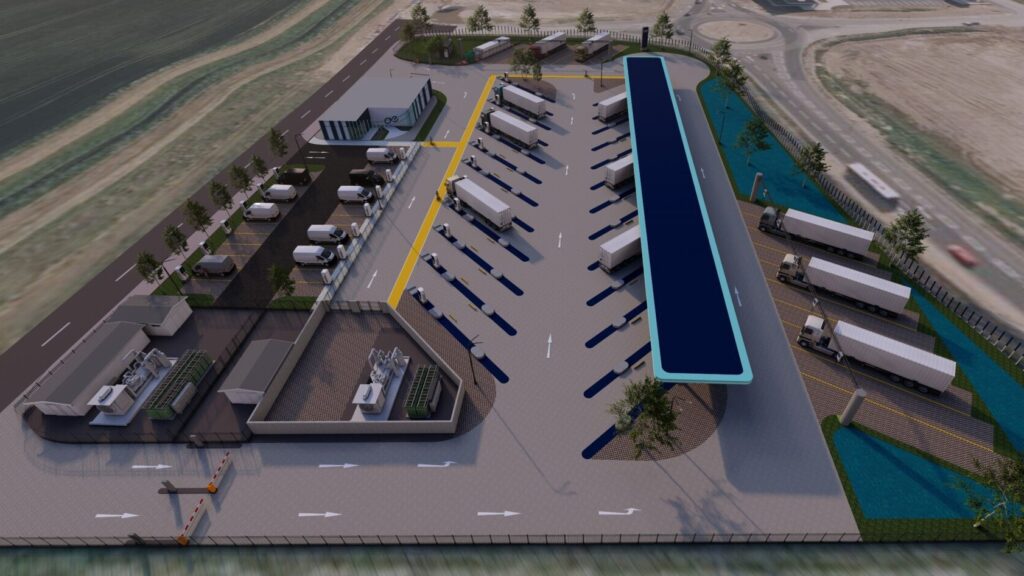
The second model of the privately operated depot runs in parallel. Transport companies with predictable routes and vehicles that return nightly increasingly see depot charging as a strategic asset.
DHL, a pioneer with more than 40,000 electric vehicles in their fleet worldwide, exemplifies this shift. Charging during operational downtime, i.e. overnight or during loading, allows companies to use the cheapest electricity, protect battery health and control one of the most critical cost inputs in logistics.
What matters here is not charging speed but reliability, optimisation and full readiness at the start of each workday.

The real breakthrough will come when these two models are integrated through technology.
Imagine a logistics ecosystem in which public hubs share real-time availability with transport management systems, and high-power charging can be booked automatically based on route planning. At the same time, depot systems plan their load intelligently, ensuring vehicles are fully charged while electricity costs remain minimal.
This is not simply cleaner transport. It is transport that operates with greater precision, predictability and commercial efficiency.
Such coordination requires a new technological architecture. Traditional on-premise station software cannot support the complexity of multiple energy carriers, dynamic pricing, distributed assets and cross-system communication. The future is cloud-based, modular and always online.
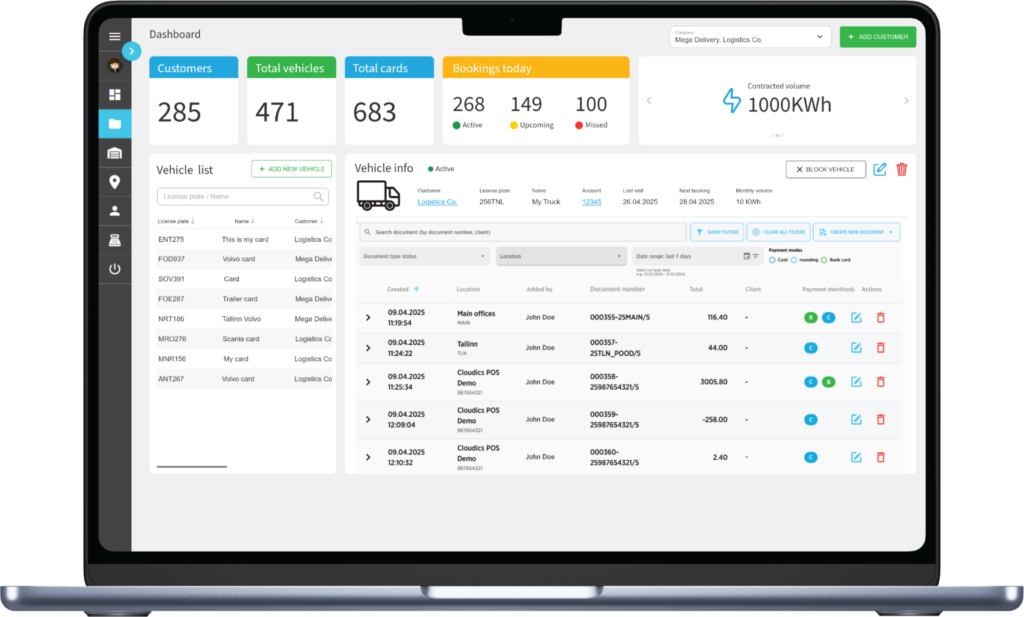
This is the role Cloudics plays as the technology link, providing an integrated platform through which both infrastructure operators and logistics companies can manage their assets, data flows, pricing, access control, and payments in a unified way.
Aegis can remotely operate their multi-energy stations; DHL can manage their depot network with real-time oversight and automated reporting. And when their systems need to interact, Cloudics enables seamless data exchange and consolidated visibility.
Technology becomes the connective tissue that transforms many moving parts into a functioning ecosystem.
Green fuels in road transport are no longer a futuristic vision – they are an operational reality.
But the transition will succeed only if the three strategic components evolve together: public infrastructure that provides confidence on the road, private depots that ensure operational efficiency, and flexible technology capable of orchestrating the complexity between them.
The companies that master this new logic will not simply comply with regulation; they will redefine what competitiveness in logistics means in the next decade.
Learn more about Cloudics EV charging platform >

Tõnu Mets
Head of International EV Sales
+372 51 15 236
tonu.mets@cloudics.com
Cloudics
Here to Streamline Business